
The launch date is on the calendar. The presentation is approved, a new page is live, and the team is preparing the announcement. Sales leadership still has a question that does not fit neatly into the celebration: who will talk to prospective customers tomorrow?
The existing reps are working current deals. The new hire has not been found. The founder intends to help but is also negotiating with suppliers and resolving the last product decisions. Early sales become something everyone plans to get to when there is time.
An external team can give a launch the capacity it is missing. First, though, the company needs to identify the work delaying its first serious customer conversations. Outsourcing can help when there are too few people to prospect and qualify buyers. If the business has not settled what it is selling or on what terms, more calls will simply expose those unanswered questions sooner.
There is a lot of work between the announcement and the first sale
A product launch is easy to describe as an event. For the sales team, it begins a series of questions that must be answered in the market.
Who needs the offer now? Who inside the account owns the problem? Is it important enough to justify finding a budget? What would the customer have to change to buy?
That last question can be uncomfortable. A new solution may save time but require training. It may reduce costs while replacing a familiar supplier. It may provide better information but need an integration the technical team cannot address for months. The advantage looks compelling in the presentation. Inside the customer's business, it joins a queue of competing priorities.
Before expanding sales activity, establish what a buyer might reasonably do after the first conversation. For equipment, that could mean discussing technical requirements. For a service, agreeing on the problem and scope. For software, attending a demonstration built around a specific use case. “They seemed interested” leaves too much open to interpretation to manage a launch.
Where an outside team can save time
An internal sales team gives a business a lasting commercial capability. Building it also requires management work: finding people, assigning roles, preparing materials, and establishing how contacts will be recorded and reviewed. When that work begins alongside a launch, leadership is effectively running two projects.
An established provider already has some of those arrangements in place. People, tools, and contact management practices exist. The client can adapt that operating foundation to its offer and agree on the engagement.
That is where a potential time advantage comes from. Its size depends on how prepared both sides are. The provider still needs to understand the product, learn its limitations, investigate the audience, and prepare its staff. Sales experience does not supply a ready answer to why a new buyer should choose this particular offer.
A new region adds another layer. The business needs to establish who controls purchasing, how service will be delivered, and which commercial terms buyers consider normal. Translating a presentation does not settle those questions.
Compare internal and external teams by the work each can complete when the launch needs it. How soon can a target account list be approved? Who will conduct substantive conversations? Who will handle the technical question that comes up on the first call? Those questions make a timeline more useful than a promise to accelerate every launch by a fixed percentage.
Divide the work before the first conversation
Outsourcing sales does not give a provider authority to change the product or promise new terms. An external team needs room to have a useful conversation and clear limits on what it can commit to.
At Axcend, we study the product and market, prepare a target account list, and obtain the client's approval. We then reach the relevant executives, present the offer, clarify needs, and confirm interest. The agreed service produces qualified prospects or scheduled sales meetings, with the context of earlier conversations included in the handoff. Final commercial terms and closing the deal remain the client's responsibility. How Axcend works.
That boundary matters during a launch. A meeting with the right buyer loses momentum quickly if the manufacturer cannot provide a demonstration specialist or confirm a delivery date.
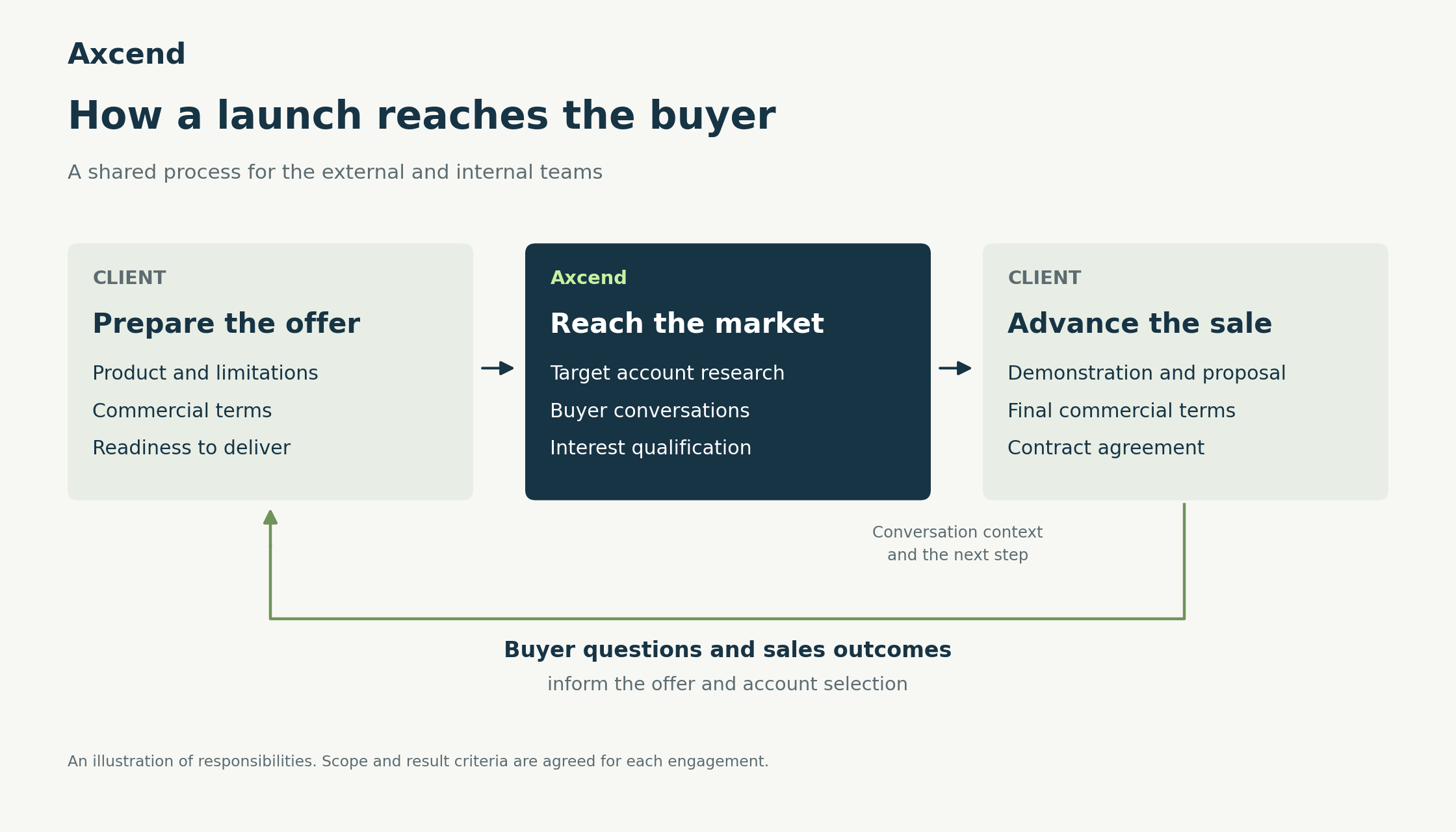
An illustration of how responsibilities can be divided. The scope of services and result criteria are agreed for each engagement.
The client needs an internal launch owner who can get decisions made. That person does not have to join every call. They do need to know who can answer an integration question, approve a special calculation, and continue a conversation with an interested buyer.
Decision authority affects the pace as much as sales headcount. In its research on product launches published in 2017, McKinsey identified collaboration among teams as an important factor in launch success. The practical implication is straightforward: a decision should not spend weeks moving between departments. McKinsey's research.
The first conversations should change the plan
Consider a hypothetical manufacturer introducing a new quality inspection system. It expects measurement accuracy to be the strongest reason to buy. An external sales team starts speaking with businesses in the selected segment.
The conversations reveal that many prospects are satisfied with their current accuracy. Interest becomes more concrete when the discussion turns to the time required to reconfigure a production line. Buyers then ask who can come to the facility quickly if the system stops working.
Reducing that response to “too expensive” or “not interested” would discard useful information. The offer may be relevant, but the conversation may start with a secondary advantage. Alternatively, the manufacturer may first need to solve a service coverage problem. Those are different management decisions. Increasing outreach volume cannot substitute for either one.
In this example, the manufacturer determines the next step. It could develop an estimate of the time lost during line changes, clarify technical support arrangements, and test the revised offer with another group of businesses. The provider helps gather buyer responses and continue conversations. The manufacturer approves changes to the product and commitments about its service.
To preserve that learning, record who participated, what problem they confirmed, what blocked progress, and what the parties agreed to do next. Rejections deserve particular attention. A dismissal from someone outside the purchasing process and a refusal from the responsible executive after discussing terms provide very different evidence about demand.
Accelerate the entire path to purchase
The first encouraging responses create pressure to expand activity immediately. Additional outreach also creates additional work: demonstrations, estimates, technical answers, and commercial approvals.
When that part of the business cannot keep pace, the queue simply moves. The external team finds interested buyers faster than internal staff can serve them. On paper, the launch has accelerated. For the customer, it has stopped at an unanswered question.
A useful launch report therefore follows several successive outcomes. Did the team reach the relevant people? Did those people confirm a problem? Did the next meeting happen? Is there a specific requirement against which the company can prepare an offer? Before the first contracts are signed, those transitions help reveal where progress is being lost.
The financial comparison also needs to go beyond an employee's salary and a provider's invoice. An internal model requires hiring and management. An external model requires client preparation and coordination. Both leave work to be done on demonstrations, negotiations, and delivery of the first orders. Assess the complete effort needed to win a customer.
Outsourcing is especially useful when a product is ready to be offered and the company lacks sales capacity for a particular market or segment. A business with sufficient internal resources can also launch quickly. The choice depends on which arrangement supports consistent selling and timely decisions about what the market is saying.
A successful launch leaves the company with more than its first meeting list. It knows who buys, which offer prompts a substantive discussion, and what the next deal will require. An external team can support that continuing sales effort, helping turn a date on the calendar into the beginning of a functioning business line.