
The new hire has CRM access, a product deck, and a script for the first call. The quiz is complete, the introductory meetings are over, and the onboarding checklist is almost entirely checked off. The manager expects results. Then a call recording reveals the problem: the rep can explain the company confidently but struggles to understand what the prospect is saying.
That is what the gap between completing training and being ready to work can look like. On paper, the employee is prepared. In conversation, they still need to learn how to choose an appropriate action: ask a question, suggest a next step, arrange another contact, or bring the exchange to a close.
For a sales development representative, that gap matters. SDRs find prospective customers and establish whether there is a reason to continue a sales conversation. Their work begins before the buyer has committed to anything, often before the buyer has any intention of discussing a purchase. Product knowledge alone is insufficient. Onboarding needs to help reps make decisions in that uncertainty and give managers evidence that learning has taken place.
The First Mistake Happens Before the First Call
Consider a hypothetical business selling maintenance services for industrial equipment. Its new SDR has learned the service list: diagnostics, scheduled repairs, and visits from field engineers. The rep can describe the benefits and knows where to find the presentation.
Ask which company deserves the first call, however, and the answer is too broad: any manufacturer. When a technical director explains that an internal team handles maintenance, the rep continues talking about field engineers. The offer has been memorized. The circumstances in which it makes sense are still unclear.
It is better to discover that gap before it appears in dozens of conversations. Give the rep several account descriptions. One manufacturer has a maintenance team but lacks expertise on a particular type of equipment. Another operates outside the service territory. A third fits the target profile, although there is no obvious reason to reach out yet. Ask the rep to choose an action for each and explain the reasoning.
The exercise reveals whether the employee understands the customer, the limits of the service, and what information is missing. “I would first find out who maintains that production line” may be a more useful answer than a flawless presentation of every service the company offers.
Training materials should therefore include examples of suitable accounts and reasons to leave an account alone. If a rep learns to see an opportunity in every business, a manager may later have to explain why a full calendar has produced so few suitable deals.
A Practice Call Should Be Allowed to Go Off Script
A script helps a new rep get started. Trouble begins when training becomes a test of how accurately someone can recite it. A buyer can interrupt, ask a question, or introduce a fact that makes the next prepared sentence irrelevant.
Return to the maintenance example. The prospect says, “Our contract runs through September.” That does not automatically mean the rep should call again in September. The company might choose its provider months before the agreement expires. The contract might renew automatically. Or the prospect might simply be trying to end the conversation politely.
A practice conversation should reveal whether the SDR notices that uncertainty. The rep might ask, “Do you review proposals in advance, or closer to renewal?” The next action depends on the answer. If the prospect does not want to discuss it, the employee also needs to know how to end the exchange respectfully.
Short scenarios with an unexpected turn are useful here. A colleague playing the buyer changes one circumstance, and the new hire explains how that changes the conversation. The manager can assess whether the employee heard the answer and responded to it, rather than grading a long, polished presentation.
Recordings of actual calls provide another kind of practice. Include a conversation that ended with a clear and appropriate rejection, one that left important information unresolved, and one that produced a useful meeting. Pause at a specific moment and ask what the rep knows, what remains unknown, and why the next question makes sense. That introduces the work without suggesting that every good call must end with an appointment.
CRM Skills Show Up in What Happens After the Call
A software demonstration rarely establishes whether an employee can preserve the meaning of a conversation for later use. A rep may know exactly where the notes field is and still fill it with “Spoke with prospect. Sent information.”
That entry gives the next person very little to work with. What interested the buyer? Which information was requested? Who is supposed to continue the conversation? Without answers, another rep may start from scratch or act on assumptions.
Give the new hire a practice call recording and ask them to take the contact through the full workflow. Find the correct record, check whether another rep owns the account, capture the conversation, send the agreed material, and create the next task. Then give the record to a colleague who did not hear the call. Can that person continue the work without asking for a separate explanation?
In the maintenance example, a useful note might read: “Service contract ends in September. Proposals are reviewed in July. Technical director requested a list of equipment we support. Agreed to speak again after the list is sent.” There is a basis for the next action. If no date was agreed, the record should make that clear as well.
This exercise can expose problems in the company’s process, too. Instructions for lead statuses may conflict, or nobody may have defined who owns the next action. New employees should not have to decipher contradictions that experienced colleagues have learned to work around.
A Calendar Helps Until It Becomes a Substitute for Evidence
A plan for the first month is useful for organizing workload, meetings, and training. Reaching a certain date, however, says little about someone’s ability to work independently. One employee can already handle a sales conversation but knows little about the industry. Another understands the market and has never made a cold call.
Define what an employee should be able to demonstrate at each stage. An experienced rep can attempt the relevant exercise earlier. If the skill is there, repeating every lesson adds little. If a gap appears, the manager has a specific training need to address.
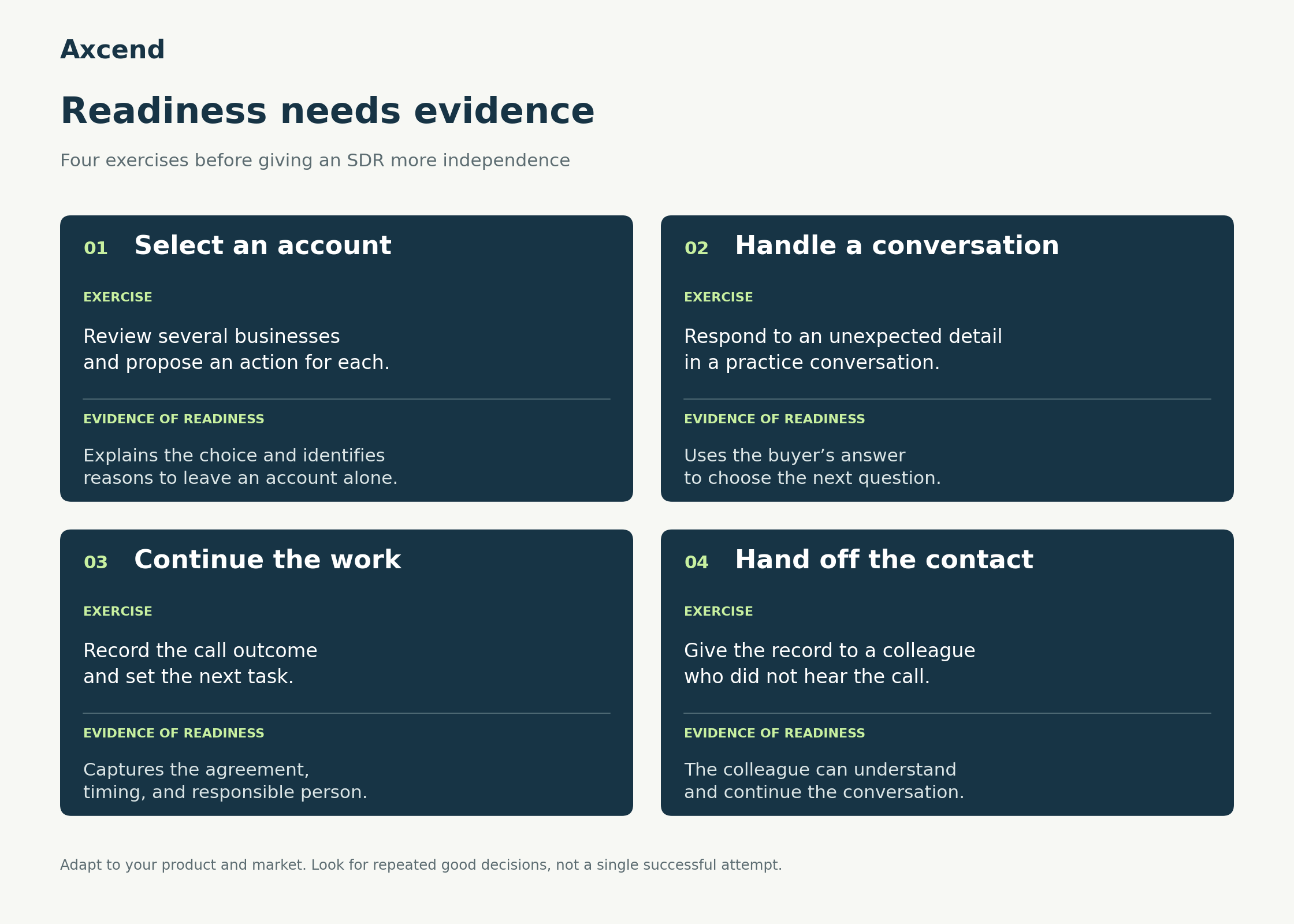
An illustrative readiness assessment. Adapt the sequence and depth of the exercises to the product, market, and employee’s experience.
Between a practice scenario and full independence, give the employee a limited amount of real work. Assign a clear segment and a manageable number of contacts, with review time already reserved on the manager’s calendar. Increase the workload when the employee demonstrates sound decisions across several situations. One successful call is encouraging, but it is not enough evidence on its own.
Explain performance expectations before the work begins: which measures apply now, when they will be reviewed, and what determines the move to a full workload. That includes incentive compensation and the rules for crediting meetings. Changing the criteria after the fact makes even a detailed onboarding plan unreliable.
The Manager’s Time Belongs in the Plan
Assigning a mentor is easy. Making time for mentoring is harder when that person has a sales target and a packed calendar. If helping the new hire remains something to do “when you get a chance,” training depends on how the rest of the team’s week happens to unfold.
Gallup reports a connection between active manager involvement and employees’ perceptions of successful onboarding. That is evidence about the employee experience, rather than a guarantee of sales improvement. The practical implication is that a manager’s involvement should be visible in the schedule and in the decisions being made.
Different people can provide different kinds of help. A colleague explains where to find information and how the working day is organized. A product specialist handles more complex questions. The manager sets quality standards, assesses progress, and decides which responsibilities the employee is ready to take on. Each role needs a named person.
For a remote team, make it explicit whom the new hire should contact and through which channel. Microsoft Research’s guidance on remote onboarding, based on employee research, highlights the value of an explicitly assigned onboarding buddy. That arrangement can make asking frequent questions feel less awkward.
Access to help does not automatically make feedback useful, though. “Be more confident” leaves the rep facing the same problem. A precise review sounds different: “After the buyer asked about repair times, you started listing services again. Let’s try answering the question and finding out what turnaround time the customer needs.” The employee practices that moment again, and the manager looks for that specific behavior in later calls.
When Results Are Weak, Find the Point of Failure
Poor early numbers can have several explanations. The rep struggles to open a conversation. The contact list is full of people who have changed jobs. The offer is unsuitable for the segment. Or meetings are taking place, but the receiving sales team disagrees with the qualification criteria.
Those situations call for different responses. Trace several contacts from account selection through the outcome, review the recordings, and discuss them with the employee. If the rep is applying the skills correctly but conversations repeatedly stall over the same limitation in the offer, more coaching on vocal confidence is unlikely to solve the problem.
Evaluate the onboarding program through specific evidence as well. Where did the employee need help? Which errors recurred? How much time went into corrections? Which meetings were accepted for further work? Comparisons with the team’s best rep need to account for segment, contact quality, and the number of conversations actually held. A small sample can give a misleading impression of either success or failure.
For Axcend, the purpose of SDR onboarding is to prepare an employee to represent the offer and pass a clear, useful result to the next person in the sale. A manager needs to see that ability before assigning a full workload.
A sensible point to close the introductory stage comes when the employee can explain decisions using real examples. Why this account? What did the conversation establish? Why was that next step appropriate? Where did the rep stop and ask for help? Those answers give a manager a much firmer basis for trust than a record showing that a presentation was viewed.