
“The others offer pretty much the same thing.” For a team that has spent years developing a product, that reaction can sting more than a price objection. The offer reflects engineering decisions, complex operations, and employee expertise. The buyer watched the presentation and saw another supplier in a familiar category.
The temptation is to explain more features or make a stronger claim of uniqueness. First, though, establish what decision the customer is making. The differences may be immaterial to that decision. The buyer may not understand them. Or the buyer may understand perfectly well and still lack enough evidence to change an established way of working.
A product differentiation strategy connects real attributes of an offer with a reason to choose it. It shapes whom a company serves, what it promises, how it delivers, and what it charges for. A persuasive message follows from those decisions.
Find Out What You Are Actually Being Compared With
Consider a hypothetical developer of software for field service teams. The product includes scheduling, mobile work orders, and reporting. Its team compares it with other applications and takes pride in the number of configuration options. The prospective customer still assigns work by phone and tracks it in a spreadsheet.
That buyer has a different question: Will a new system justify the time needed to migrate data, train staff, and change routines? More configuration options may deepen the hesitation if the customer sees them as additional work.
Positioning consultant April Dunford argues for considering the buyer’s actual alternatives, including keeping the current process. A list of similar products on the market does not establish which choices a particular customer is weighing.
In the field service example, investigate where the current process falls short. Do assignments get lost between dispatchers? Do technicians complete reports after their shifts? Does the manager struggle to confirm which jobs are finished? A small team may also be managing perfectly well, with little reason to switch yet.
The answer changes the comparison. If the problem is preserving complete records of finished work, demonstrate the path from an assignment to a verified result. A tour of every configuration option answers a question the buyer may never have asked.
Decide Who Benefits Most From the Difference
The same capability can carry different value for different companies. Working without a continuous network connection matters to crews visiting locations with unreliable coverage. It may have little influence on the choice of a team that spends its day in well connected buildings.
Two forms of differentiation are useful here. Vertical differentiation concerns an advantage on a comparable quality or performance measure, such as fewer errors on the same operation under the same conditions. Horizontal differentiation concerns fit with different preferences or needs. Software with predefined processes may suit a small service company, while extensive configuration may be preferable for a complex organization.
No single measure makes a product the best choice for everyone. A fast implementation generally needs a defined scope and limits on customization. Extensive configuration takes time to design. Buyers need to understand what comes with the approach they choose.
The Harvard Business School value proposition framework connects the customers a company serves, the needs it meets, and a relative price that works for customers and the business. That makes differentiation part of the business design, rather than an isolated advertising claim.
For field service software, a useful segment description might focus on working conditions: technicians regularly visit locations with unreliable connectivity, and a completed report is needed before they return to the office. That description contains a reason for interest. “Suitable for every service business” leaves that reason unexplained.
Match the Evidence to the Promise
A product attribute and a commercial outcome are separated by several steps. Offline functionality can be demonstrated in the application. Fewer lost reports require an assessment of the working process. Revenue growth requires a much fuller explanation because many factors influence it.
Match each promise to evidence that can support it. In the field service example, agree on a test: open an assignment without a connection, complete the report, reconnect, and check what the dispatcher receives. If another product is included in the comparison, use the same conditions.
That test establishes a specific capability. Understanding its everyday value requires observing use: whether information is preserved, how many corrections are needed, and whether employees must enter the same data again. A successful demonstration should not become a promise of identical business results for every customer.
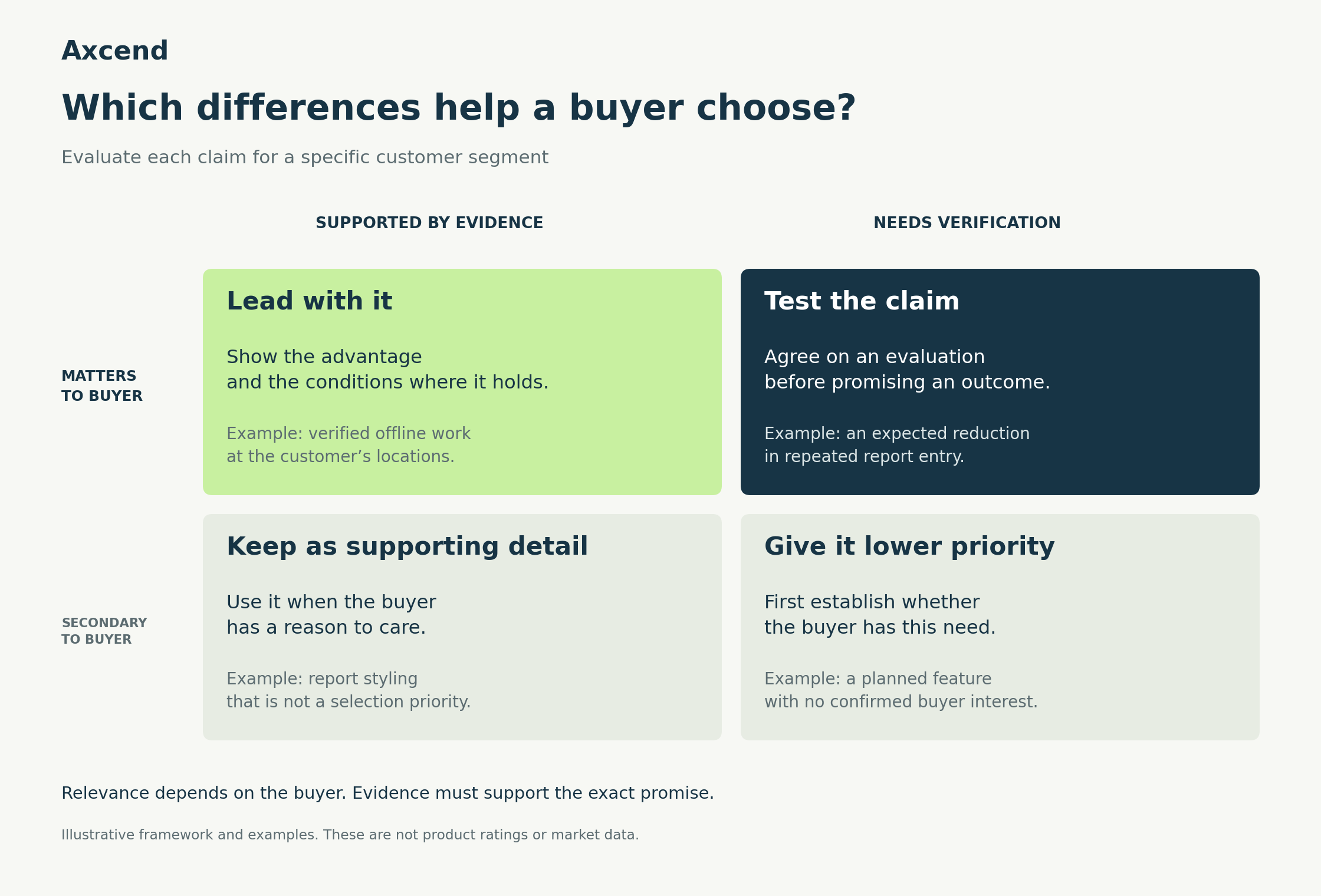
A working framework for evaluating sales claims. Assess relevance for a specific segment and evidence against the exact promise being made.
Competitive comparisons need the same care. If another application works offline, the presence of that function alone does not establish a difference. There may be a meaningful distinction in the tasks available, the ease of configuration, or user support. If there is no material difference, that is useful information for the product team.
Transparent terms can also provide evidence. A defined implementation scope, clear acceptance procedures, and sample documentation help buyers evaluate the offer before signing. They matter particularly when the customer’s main concern is what will happen after the sale.
Delivering the Promise Requires Operational Choices
Suppose the vendor decides to stand out through rapid implementation. The claim appears on the website, and reps begin repeating it in meetings. Yet every data migration requires manual work, training depends on when specialists become available, and configuration scope is settled only after payment.
The problem now sits inside the organization. The company needs to define a standard implementation, prepare templates, make specialists available, and explain the conditions that affect timing. Otherwise, the promise creates expectations the team cannot reliably meet.
The Institute for Strategy and Competitiveness at Harvard Business School connects differentiation with distinctive activities. The value offered to customers needs support from how the company creates and delivers its product.
The same applies to service. “Personal support” becomes a meaningful advantage when buyers know who helps, which tasks are covered, when help is available, and what happens if the primary contact is absent. Naming an account manager in a contract does not establish support quality.
Boundaries matter as well. If a standard implementation excludes a complex integration, explain that before the sale. Clear limits let the customer evaluate the offer and help the supplier maintain delivery quality and workable economics.
The Pricing Model Can Be Part of the Value
Different pricing structures distribute expense and uncertainty differently. A seasonal service business may prefer paying for active employees to purchasing a fixed number of annual licenses. A team with consistently heavy usage may prefer a predictable fixed payment.
Neither option can be declared better without specifying the comparison. Show the buyer what counts as activity, which payments are mandatory, what implementation costs, and how the bill changes as use grows. Scenarios for a normal month and a peak period are useful when they cover the same workload.
The supplier also needs to establish whether the model covers support, infrastructure, and implementation. Flexible terms lose their appeal if unexpected charges or reduced service later compensate for them.
In services, the unit being purchased is especially important. A meeting, confirmed interest, a completed project, and a paid sale involve different work and responsibilities. A precise definition of what is being charged for makes it easier to compare offers and judge which one fits the task.
Test Whether a Rep Can Explain the Difference in Conversation
Return to the field service application. Instead of calling it a flexible, modern platform, a rep could say: “When your technicians work at locations without coverage, they can complete reports on site and send them once they reconnect. In a demonstration, we can test that process using one of your typical work orders.”
That statement identifies a relevant situation, a product capability, and a way to check it. It works only if the function performs as described and the situation applies to the buyer. The emphasis may change at the next account while the underlying product facts remain consistent.
The outreach channel helps communicate the difference. A short call may establish whether the problem is relevant, and a demonstration can test the process. Choosing a phone call, email, or event does not by itself explain why someone should buy. The quality of the interaction becomes part of the advantage when it provides competent help with selection and use.
At Axcend, sales preparation includes examining the offer, the market, and the buyer’s alternatives. That work needs a clear account of who benefits from a difference and how it can be demonstrated. The connection supports a substantive approach to prospects instead of an identical benefits presentation for every business.
Evaluate the message through the substance of responses. Does the buyer recognize the situation? Ask to see the relevant capability? Agree to discuss an evaluation? A higher email open rate alone does not establish strong positioning.
A reason to choose becomes persuasive when the buyer can explain it internally: this offer fits our conditions, the material advantage can be checked, and the cost and limitations are clear. That argument survives the end of the presentation and continues to work when the salesperson is no longer in the room.