
The seller opens the presentation. By the second slide, the buyer interrupts: “We’ve already reviewed this. We have a comparison of three suppliers. Help us understand which specifications will actually affect our costs.”
There is good news in that exchange. The buyer is interested and has already done some of the work. There is also an uncomfortable implication: the standard presentation has lost much of its purpose. The seller now needs to examine someone else’s conclusions, understand operating conditions, and explain differences that a specification table cannot resolve.
That is a useful place to look for the future of B2B sales. Commercial teams will increasingly meet buyers who bring their own information, a preliminary position, and specific questions. Their value will depend on how well they work with that preparation.
More information does not always mean greater confidence
Consider a hypothetical manufacturer buying new compressed air equipment. An employee has reviewed catalogs, watched videos, and asked AI to compare the options. A spreadsheet neatly lists output, energy consumption, and price. Yet the plant’s operating conditions differ from those used to establish some of the specifications. The analysis looks complete before there is enough evidence to support a decision.
This buyer may know certain product details better than the salesperson. They still need to understand how the equipment will be replaced, who will service it, and which assumptions drive the estimate of future operating costs. Extensive independent research does not eliminate the need for verification.
In a Gartner study published in May 2026, 69% of surveyed B2B buyers preferred to validate AI insights with sales reps. The survey covered 645 buyers and was conducted in August and September 2025. It indicates continued demand for that verification, although it does not establish the preferences of every market or customer.
For the seller, this changes how a meeting should begin. Ask the buyer to show the basis of their comparison and explain what remains uncertain. If the spreadsheet contains an error, examine it calmly with the relevant document or calculation available. Trying to prove superiority over a prepared customer makes the conversation harder.
Sometimes the best outcome of the meeting is agreement that one option needs more investigation. Precisely identifying what is still unknown becomes part of commercial competence. An unsupported answer may move today’s discussion along while creating an expensive dispute after delivery.
Buyers choose the way they want to work
A customer may research configurations independently, speak with an engineer over video, visit a test facility, and negotiate terms by email. They do not have to follow those steps in the supplier’s preferred order. Their goal is to assemble enough evidence to make a purchase without spending unnecessary time doing so.
McKinsey’s Global B2B Pulse 2026 emphasizes consistent information as buyers move between digital channels and conversations with people. The research covers nearly 4,000 participants across 13 countries. For a commercial leader, the practical implication is that websites, correspondence, and specialist access should help customers continue their evaluation without repeatedly starting over.
For an equipment manufacturer, that starts with ordinary decisions. Current specifications are available without booking a meeting. The standard configuration is clearly distinguished from items priced separately. A request for testing reaches someone who can see the requirements already discussed. The buyer does not spend another half hour explaining how the plant operates.
Delivering that experience takes internal discipline. If the website describes one configuration, the proposal specifies another, and service learns about the commitments only after signature, adding more channels will accomplish little. Someone needs to own the current version of each specification, price, and promise.
That continuity matters when an external sales team is involved. For Axcend, preparing outbound outreach includes understanding the offer, the target customer, and what constitutes qualified interest. When a contact moves to the client’s internal sales team, the seller needs to continue a specific conversation. Shared context connects the initial approach with the commercial work that follows.
Automation changes how responsibility is assigned
When AI gathers account information, drafts a message, or summarizes a conversation, familiar tasks may take less time. A quickly produced document does not establish that the commercial job is finished, however. The team still needs to distinguish verified information from inferred conclusions and understand which actions have actually been authorized.
In the equipment example, a system might prepare a comparison using supplied documents. An engineer checks whether the measurement conditions are comparable. The seller determines which parameters matter to this plant. The project owner confirms whether the promised schedule is feasible. Work is distributed, and each decision has a clear basis.
As automation develops, software may take on parts of those activities as well. It is more useful to define the rules for a particular operation than to permanently assign a broad category of work to either people or machines. Which documents are current? Who approves an exception? What discrepancy requires the process to pause for review?
A particularly awkward failure occurs when a tool effectively receives more authority than intended. An automatic reply describing a standard delivery window may be understood by the buyer as a commitment for their project. The cause can be organizational: nobody separated general information from an agreed commercial term.
Managers should measure the full path to a usable result. How much time went into preparation, review, and corrections? How often did someone have to return to the customer with a clarification? If the first draft became faster but the engineer now spends longer finding errors, the benefit to the team is still unresolved.
Trust is tested in the difficult part of the conversation
Relationships in a complex sale are built through the supplier’s behavior when a constraint emerges. The proposed installation date is unavailable. The payback calculation is still approximate. The customer must complete certain preparations before delivery.
This is where industry knowledge earns its place. The salesperson does not need to design the equipment personally. They need to recognize when the discussion has reached a condition that changes the offer and bring in the appropriate specialist. A knowledge gap becomes a commercial problem when confident language is used to conceal it.
Understanding people matters just as much. A production manager may accept the technical benefits while postponing a decision because of concerns about downtime. The finance director may support the investment but need to understand which budget period will bear the expense. Another presentation will not resolve those differences.
Emotional awareness has a practical role here. The seller notices tension and checks their interpretation with a question. They do not label the buyer indecisive or diagnose a hidden motive from a single pause. They help assemble evidence that each participant can use to discuss the decision internally.
For the production manager, that might mean an agreed replacement plan and test conditions. Finance needs transparent assumptions behind the cost estimate. Procurement needs clear responsibilities and a process for changing terms. The offer becomes more credible through those details.
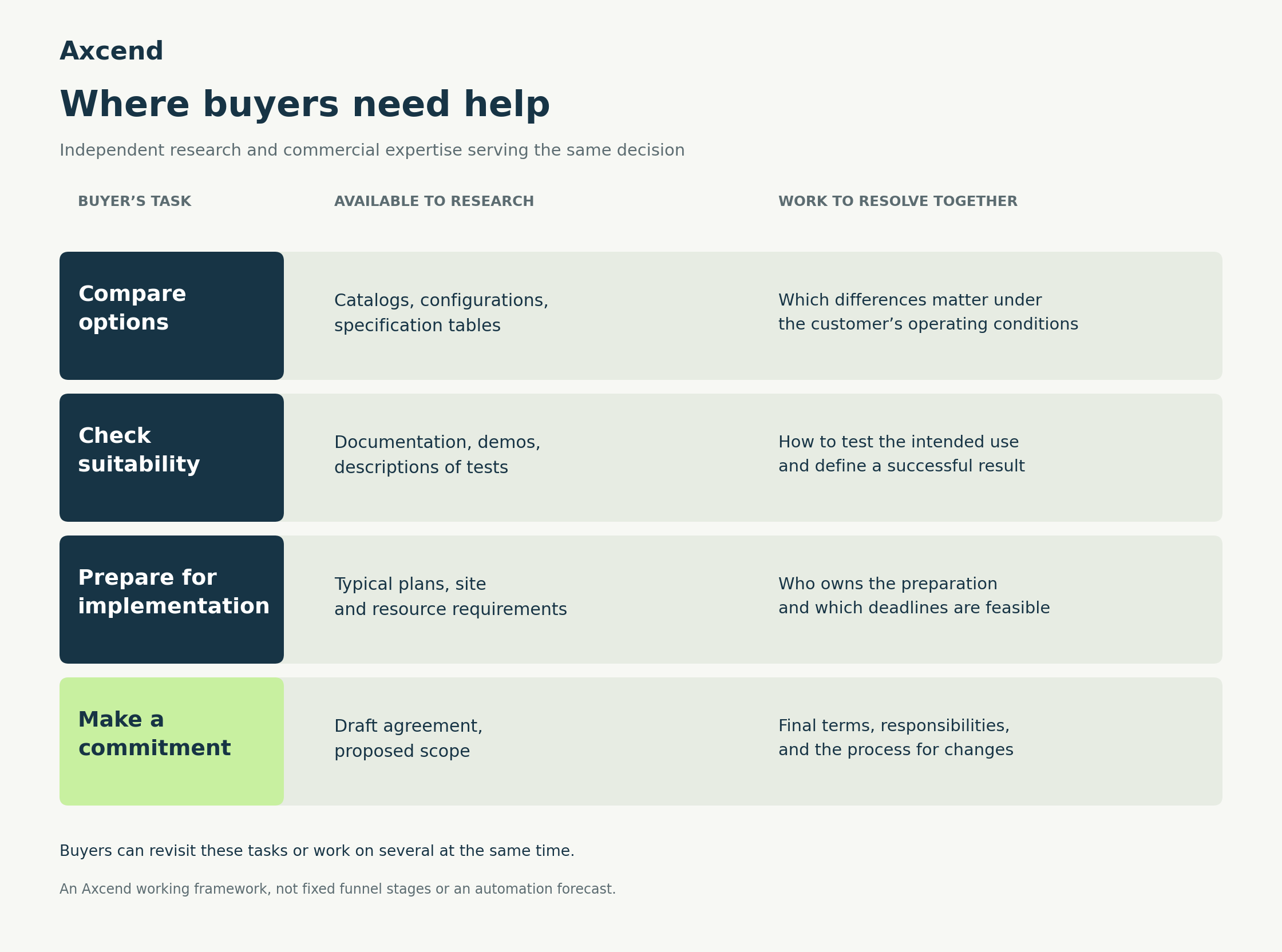
An Axcend working framework for a complex B2B purchase. Tasks can recur or run in parallel. This is not a fixed sequence of stages or a forecast of automation rates.
The whole team needs to keep learning
These expectations affect both hiring and the development of existing employees. A candidate’s record matters, but so do the conditions in which it was achieved. Someone may have sold a familiar product successfully to established customers. Entering a new market with an unfamiliar offer requires different preparation.
A short work exercise can reveal how a candidate learns. Provide a product description, a hypothetical buyer’s requirements, and a comparison containing conflicting information. Observe what they verify, which questions they ask, and how they justify the next step. Then introduce a new constraint, such as a limited installation window. What matters is how their judgment changes.
For the existing team, learning can begin with actual commercial discussions. Examine why a buyer rejected a calculation. Identify a technical dependency that surfaced too late. Update the material every seller uses. Knowledge then becomes available to the organization instead of remaining one employee’s private experience.
Data can help select the subject of that review. Buyers in one segment might attend demonstrations readily but rarely agree to a trial. Before replacing the script or the software, check whether the trial conditions are clear, whether preparation has an owner, and whether both sides know what a successful result would look like. An observation becomes a specific hypothesis that can be tested in subsequent deals.
A team can begin changing its approach at one point where buyers already struggle to move forward. Improve the materials, assign ownership of the answer, bring in the necessary expertise, and examine the result across comparable inquiries. Useful measures might include time to a substantive response, repeated requests for clarification, or progression to an agreed next action. The task determines the metric.
The future of a commercial team takes shape through these decisions well before it appears as the name of another platform in the budget. A prepared buyer creates an opportunity for a more substantial conversation. A capable sales organization uses that opening and leaves the customer with greater clarity than they had before the meeting.