
“Please send us your pricing.” For a salesperson, it sounds like a promising start. The buyer has brought up a purchase. All that remains is to confirm volume, prepare a quote, and send it over. A week later, the email still has no response. Perhaps the price was too high. Perhaps the buyer was working on a different problem that the seller never understood.
The same request can mean several things. A company may be checking the market before negotiating with its current supplier. It may need a backup source, be preparing a product launch, or be investigating a quality problem while opening the conversation with price.
Discovery helps a seller understand that distinction. By the end of the conversation, the rep should know what decision the buyer is considering and what will shape it. The buyer should also gain something from the exchange, beyond the experience of filling out someone else’s questionnaire aloud.
Find Out Why the Request Appeared Now
Consider a hypothetical packaging manufacturer that receives an inquiry from a food producer. The package dimensions and expected order volume are available, but the reason for looking at a new supplier is unclear.
One opening question is, “What prompted you to request a new quote at this point?” It leaves room for the buyer’s explanation. Asking what is wrong with the current supplier already assumes dissatisfaction. The buyer may be perfectly satisfied and simply need a backup source.
The answer determines where to go next. A price comparison calls for questions about the specifications and terms being compared. A backup supply requirement calls for a discussion of when additional capacity might be needed and at what volume. A quality complaint requires a closer look at the actual defect.
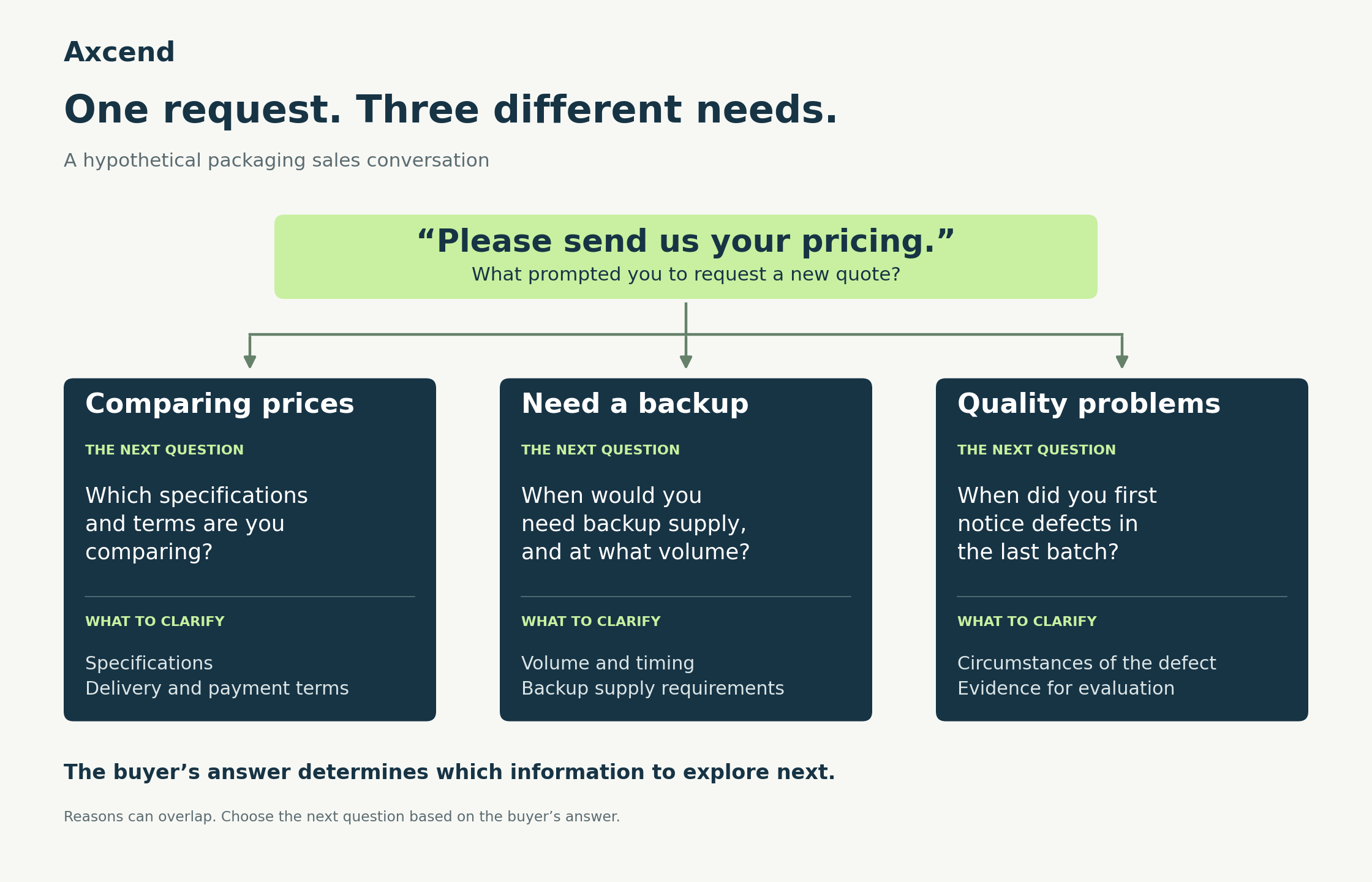
A hypothetical packaging sales example. Reasons can overlap, so use the map to guide clarification.
Questions should not become a barrier to getting a price. If there is enough information, provide a quote or a defensible range with the relevant conditions. Then explain what else is needed for a precise proposal. Withholding pricing until a buyer completes a lengthy interview does little to make the conversation useful.
Ask the Buyer to Walk Through One Actual Incident
Suppose the buyer explains that some packages are losing their seal. A rep may recognize a familiar problem and immediately suggest a different material. But that statement alone does not establish when the defect appears or what needs to change.
“Could you walk me through the last affected batch? At what stage did you notice the problem?” The question turns a general complaint into a sequence of events. The defect might have been discovered on the production line, in storage, or after transportation. Those are different starting points for a technical specialist to investigate.
The next question follows from the answer: “How did you establish how much of the batch was affected?” The buyer might have inspection results, photographs, or only a handful of reports so far. The seller can begin separating established facts from an initial estimate.
This is a poor moment to substitute confidence for diagnosis. Promising that different packaging will eliminate the defect is premature when the cause is unknown. A useful outcome may be an agreement to exchange samples and technical information. The commercial proposal should then account for that evaluation step.
The same approach works in services. “Our contractor keeps letting us down” deserves a specific example: what was agreed, what happened, and how the company found out. One concrete incident can provide more useful material than a long list of general frustrations.
Establish What Has Been Tried and Why the Issue Matters
Before recommending a solution, ask, “What changes have you tested since that happened, and what did the tests show?” The food producer may already have evaluated another material, adjusted its equipment, or not yet started testing.
Each answer changes the seller’s work. Repeating an unsuccessful test without a new reason makes little sense. If the contact does not know the result, find out who does. If the company has already found a solution that works, establish why it is considering another supplier.
Then explore the operational effect: “What did your team have to do differently with that batch?” The answer might involve another inspection, extra handling, a shipment delay, or returned goods. These are concrete circumstances that help both parties discuss the issue’s importance.
Huthwaite’s SPIN methodology uses questions about implications to connect problems with their business significance. It also describes its question types as a flexible framework. The sequence needs to reflect what the buyer has already explained.
When costs enter the conversation, ask, “Have those expenses been measured, or are they still an estimate?” An assumption should not become a persuasive number in a presentation simply because the seller needs a business case. Instead, agree on the information that would support a comparison, such as additional labor, returned volume, or repeat shipping costs.
The issue may turn out to have a low priority. Perhaps the incident was isolated and its cause has been resolved. A useful sales conversation leaves room for that finding. Making the buyer more anxious does not make a proposal more valuable.
Agree on What Would Count as Evidence
“We need consistent quality” sounds clear until two proposals have to be compared. How will the company assess consistency? Through sample testing, a production run, storage performance, or several deliveries? Who will define the requirements and confirm the results?
A useful question is, “What would a new option have to pass before you could consider it for purchasing?” That helps define a concrete next step. Packaging may require agreed tests. Business software may need an evaluation using customer data. A service may call for a limited pilot with a specified outcome.
Then ask, “Which conditions cannot change, even if other results improve?” The buyer might identify equipment compatibility, material requirements, delivery time, or payment terms. It is better to understand these constraints before preparing a quote, especially if the seller cannot meet them.
Past supplier experience belongs in this discussion as well. Rather than inviting a catalog of disappointments, ask, “What should we plan for during a transition so you do not run into the same difficulties again?” If artwork approval previously caused delays, the proposal should establish an approval process and the people responsible. A promise of attentive service is unlikely to be enough.
Understand How the Conversation Could Become a Purchase
An interested contact may not know the entire decision process. They may be gathering technical options while financial approval comes later. The seller needs to understand that process without dismissing the contribution of the person already helping explain the problem.
Ask, “After a successful evaluation, what approvals would still be needed before the first order?” The response can identify who assesses quality, who approves commercial terms, and who places the order. It also helps determine who should join the next discussion and what material they will need.
Money deserves a practical conversation: “Will you compare cost per unit, or include delivery and additional handling?” If there is a spending limit, discuss it directly. If the budget is still being developed, establish what calculations are needed for approval. The absence of a stated amount does not, by itself, explain whether the company is ready to buy.
Test the timeline against an event: “By what date does the new option need approval, and what determines that date?” A product launch, contract expiration, and routine purchasing review create different circumstances. With a date and a set of required actions, both parties can judge whether the plan is feasible.
These topics do not all belong in an initial cold call. At that stage, it may be enough to establish the reason for interest and agree to a substantive conversation. Detailed discovery requires time and a buyer who is ready to engage in it.
A Useful Conversation Changes What the Seller Does Next
Prepare questions, but avoid turning the question count into the objective. In an analysis published by Gong in 2017, a particular number of discovery questions was associated with successful calls. The authors explicitly distinguished correlation from causation. That observation should not become a mandatory quota for every conversation.
After a substantive answer, the right response may be another question or a brief explanation from the seller. When a buyer asks about a material or a delivery date, an answer is needed. Responding to every question with another question places all the work on the buyer.
Close by bringing the agreement together: “First, we’ll evaluate seal performance on your line. You’ll share the requirements from your technical team, and we’ll prepare samples and a quote for the agreed volume. After testing, we’ll discuss an initial order. Is that the right sequence?” This gives the buyer a chance to correct a misunderstanding before the proposal is prepared.
For Axcend, discovery gives an offer a specific business purpose. It clarifies why the company might continue the conversation, which questions remain open, and who can answer them.
A useful discussion may lead a seller to change the proposal, involve a specialist, suggest an evaluation, or acknowledge that the right solution is unavailable. If the buyer’s answers change nothing about the next action, revisit the questions. The customer made time for a conversation and deserves to see that time reflected in the result.