
Almost everyone in a sales meeting can agree that the company needs more customers. Agreement gets harder when the discussion turns to which customers are worth pursuing and how much the business can spend before those accounts start paying their way.
Put off that discussion, and a strategy will emerge anyway. Marketing buys traffic. Sales asks for a bigger prospect list. Management approves another campaign. Activity rises, but the business still cannot explain why some customers sign and stay while others disappear after the first conversation.
A useful acquisition strategy begins with a choice about the demand a company can serve profitably. That choice shapes who gets approached, what the company offers, and where it spends. It also requires leaving some appealing opportunities alone.
The cheapest lead can produce the most expensive customer
Consider a hypothetical service provider testing two acquisition channels. Each receives $12,000, including campaign spending and the team's work attributable to it. Both groups of prospects have had enough time to move through comparable sales cycles.
Channel A generates 240 inquiries. Channel B produces just 60. Judged by cost per lead, the contest looks settled: $50 versus $200. Channel A gives marketing an attractive number to present at the next meeting.
Then sales closes the accounts. Four companies buy through Channel A. Six buy through Channel B. The cost to acquire a customer comes to $3,000 and $2,000, respectively. The channel with the expensive leads has delivered the less expensive customers.
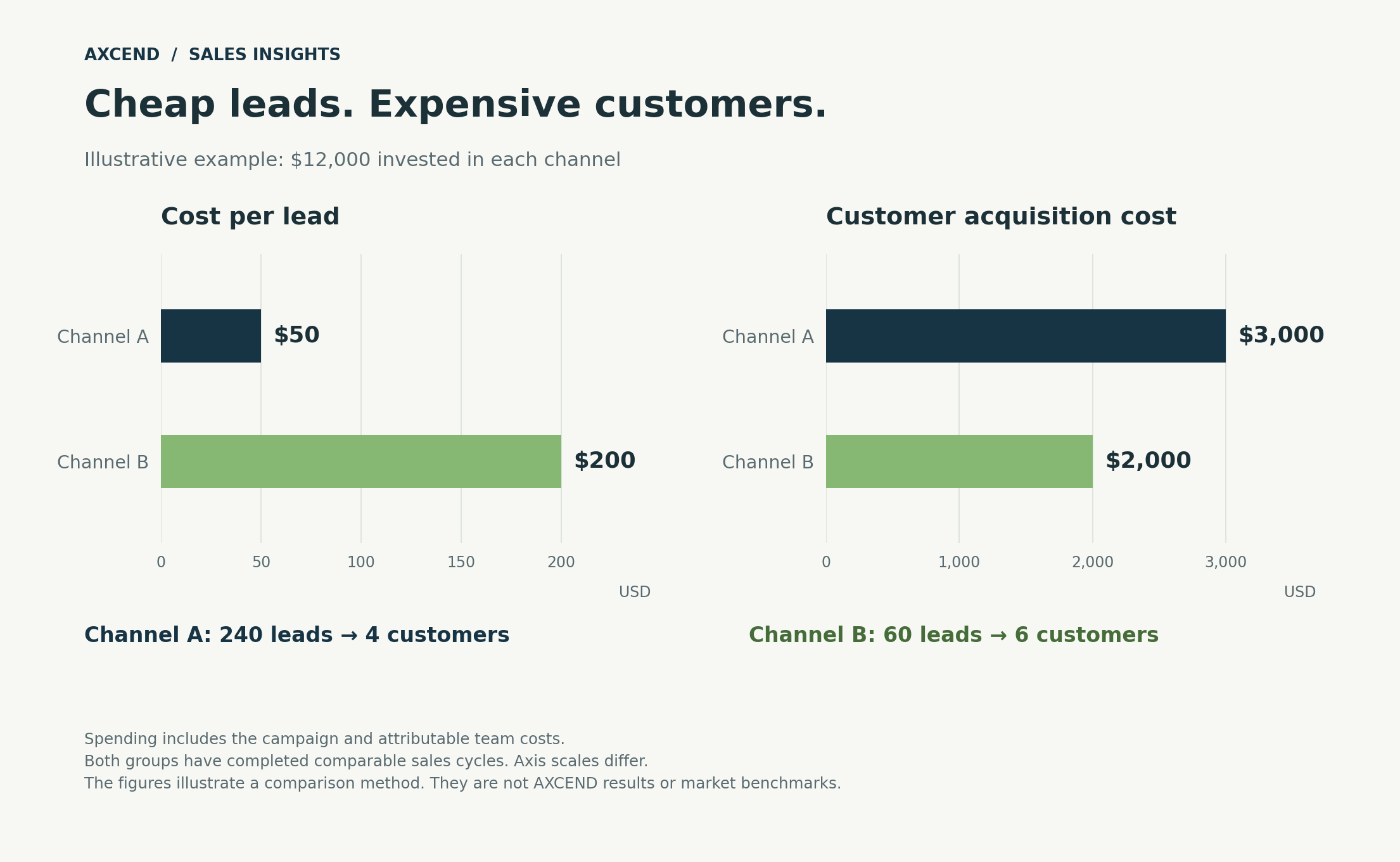
Illustrative calculation, not an industry benchmark or AXCEND performance data. Each channel costs $12,000. Channel A produces 240 leads and 4 customers. Channel B produces 60 leads and 6 customers. The comparison assumes consistent cost allocation and enough time for sales to close.
Even now, moving the budget would be premature. Customers from Channel A might place larger orders, pay sooner, or need less support. Any of those differences could justify a higher acquisition cost. A sensible channel decision follows the account beyond the signed contract.
Customer acquisition cost, usually called CAC, divides the relevant costs of marketing and sales by the number of new customers acquired. Counting only advertising leaves part of that investment out. Timing matters, too: with a lengthy sales cycle, this month's spending cannot automatically explain this month's wins. Stripe outlines the costs and timing involved in calculating CAC.
Payback needs a separate calculation. Customer revenue must also fund the work of delivering the product or service. To assess recovery of acquisition spending, use gross profit after direct delivery costs. A payback calculation needs to account for the cost of serving the customer.
Suppose each customer in our example produces $600 in monthly gross profit. Channel A recovers its acquisition cost in about five months; Channel B takes about 3.3 months. That simplified estimate assumes steady monthly profit, no churn, and no additional initial costs. It is not a cash forecast. Payment terms could leave the business waiting longer for the money.
Find the customer with a reason to act
“Midsize manufacturers” is a useful filter for building a prospect list. It is an incomplete basis for selling. The category includes companies adding capacity, cutting investment, replacing suppliers, and getting exactly what they need from their current arrangements.
The seller needs to understand the circumstances that make an offer timely.
For an equipment maintenance provider, that might be a new production line. For a warehouse systems company, an expanding distribution network. For an outsourced sales team, a customer's move into a market where it has no employees. These are possible reasons to start a conversation. Each still needs checking; none establishes an intention to buy.
Build the customer profile from specific accounts. Look at customers whose relationships have proved profitable. What was happening before they contacted the company? Who first raised the purchase internally? What nearly prevented the agreement? Put lost deals alongside those wins. They can reveal the limits of an attractive segment more clearly than a collection of success stories.
Then examine delivery. A large contract that requires extensive manual work may contribute less than a smaller repeat order. Targeting accounts the company struggles to serve creates an obligation that pricing may never cover.
A practical selection rule emerges from that work: a recognizable customer problem, access to the people involved in the decision, and conditions under which the business can deliver at an acceptable profit. Industry and employee count remain useful filters. They no longer have to stand in for the entire commercial argument.
Give buyers the next answer they need
Imagine an operations director whose warehouse cannot keep up with demand. She has not decided whether to replace software, redesign processes, or hire more people. An invitation to watch a specific product demo may arrive too soon. An explanation of how to diagnose the delays could be more useful.
Later, she begins comparing vendors. Her questions change. She needs to understand implementation constraints, compatibility with existing systems, and the transition plan. A general article about the benefits of automation has little left to contribute.
Those questions also spread across the organization. Operations considers disruption. Finance checks the costs. A technical specialist looks for integration risks. An interested contact may struggle to move a purchase forward without material that helps colleagues assess it.
In research published in March 2026, Gartner reported that 67% of surveyed B2B buyers preferred a purchasing experience without a sales representative. The survey included 646 buyers. That is a preference about the buying experience, not evidence that sales teams have become unnecessary. Gartner's findings.
For a supplier, the practical implication is to make basic answers available without requiring a call. Clear terms, concrete applications, and honest limitations help buyers prepare. A salesperson can then use the conversation to investigate the customer's situation and determine whether the offer fits.
Give each channel a specific job
Debates about whether outbound or content “works better” often begin before the real problem is clear. The more useful starting point is where the company is losing the chance to win an account.
When suitable organizations are identifiable but unfamiliar with the offer, direct outreach provides a way to test interest. When buyers are already searching for a particular service, search advertising can meet existing demand. When an offer needs explanation, the business needs material that can survive scrutiny inside the customer's organization.
| Situation | What to test | What would count as progress |
|---|---|---|
| Suitable accounts are identifiable and there is a concrete reason to contact them | Targeted calls and emails | Conversations confirming a relevant problem and an agreed next step |
| Buyers are actively looking for a specific service | Search visibility and ads against commercially relevant queries | Customer wins and acquisition cost by query group |
| The decision needs explanation and internal agreement | Expert content, use cases, and implementation guidance | Questions those materials resolve in actual sales opportunities |
| Another business already has relationships with the audience | Partner referrals with clear responsibilities | Profitable wins after partner compensation |
These are starting hypotheses. Search traffic may bring students instead of purchasing managers. A partner can introduce plenty of contacts while misunderstanding the qualification criteria. A cold email offers little reason to respond when its only personal detail is the recipient's name.
Channels also interact. McKinsey's 2024 B2B Pulse research found that buyers used an average of ten ways to interact with suppliers throughout a purchase. That supports making information consistent across interactions. It does not require a small company to launch ten campaigns at once. McKinsey's research.
A smaller team can start with one primary acquisition method and give it adequate support. After a call, the buyer receives the promised material. The website presents the same terms. At the meeting, the next person continues the conversation instead of asking the customer to explain everything again. Coordination earns its place in the strategy by removing work the buyer would otherwise have to do.
Scale the results the team can explain
Before launching a campaign, write a short operating agreement. Identify the audience, the reason for contacting it, what qualifies as a substantive response, who continues the conversation, and when the results will be assessed. Set a spending limit and define what would justify stopping the test.
That agreement becomes especially valuable when an outside provider is involved. A researched contact, a scheduled meeting, and a sales opportunity ready for a detailed discussion leave different amounts of work for the client. Someone needs to own that work before outreach begins.
The less visible part of the strategy comes next: investigating what happened. If the right people reply but will not discuss the problem, sending more emails may do little for the offer. If meetings happen but proposals stall in finance, the buyer may need a stronger business case or clearer terms. If new customers leave quickly, examine the promises made during sales and the experience of delivery.
Channel reporting can help locate those problems, but it cannot explain every purchase. A buyer might hear about a company from a colleague, read an article, and eventually submit an inquiry through an ad. Google Analytics assigns credit to observed interactions according to the selected attribution model. The model affects which channel gets recognized in the report. Google's documentation.
It is worth adding a direct question to those records: what prompted the buyer to contact the company now? The answer can illuminate a recommendation, a useful document, or a conversation that tracking never captured.
Increase investment after the approach produces repeatable results across several comparable groups of buyers. Watch the cost of the next customer as well as the historical average. Early wins may have come from the easiest part of the market. An attractive average can conceal deteriorating performance in newer campaigns.
A workable acquisition strategy leaves management able to explain who the team is pursuing, why those buyers might respond, and what it will take to turn their interest into profitable business. The next budget discussion becomes more concrete. The company can specify the work that additional spending should accomplish and the evidence that will show whether it did.