
The proposal has been sent. The buyer asked questions, attended a meeting, and promised to discuss the terms with colleagues. The opportunity looks active in the CRM. Then the conversation stalls, and every subsequent message from the seller becomes another request for an update.
The reason may have little to do with price. Inside the account, people may still disagree about the problem, who will manage implementation, or whether the current arrangement needs to change at all. The seller is discussing vendor selection. The buyer is still trying to agree on the purchase.
A buyer journey map helps make that gap visible. It describes what people inside the business need to understand, verify, and agree on before deciding. Its practical value appears when another reminder becomes specific help with an unresolved question.
One purchase can contain several different questions
Imagine a company choosing an outsourced warehouse operator. Its logistics leader wants to handle seasonal peaks. The finance director needs to understand the full service cost. The IT specialist is investigating how orders and inventory records will move between systems.
Logistics already finds the offer persuasive. Finance still questions whether to outsource the work. IT has not received the data exchange specification. Assigning one level of readiness to the whole account loses much of what matters.
An interested contact therefore may not be able to advance the purchase alone. That person needs answers for colleagues who missed the demonstration and judge the offer against different criteria.
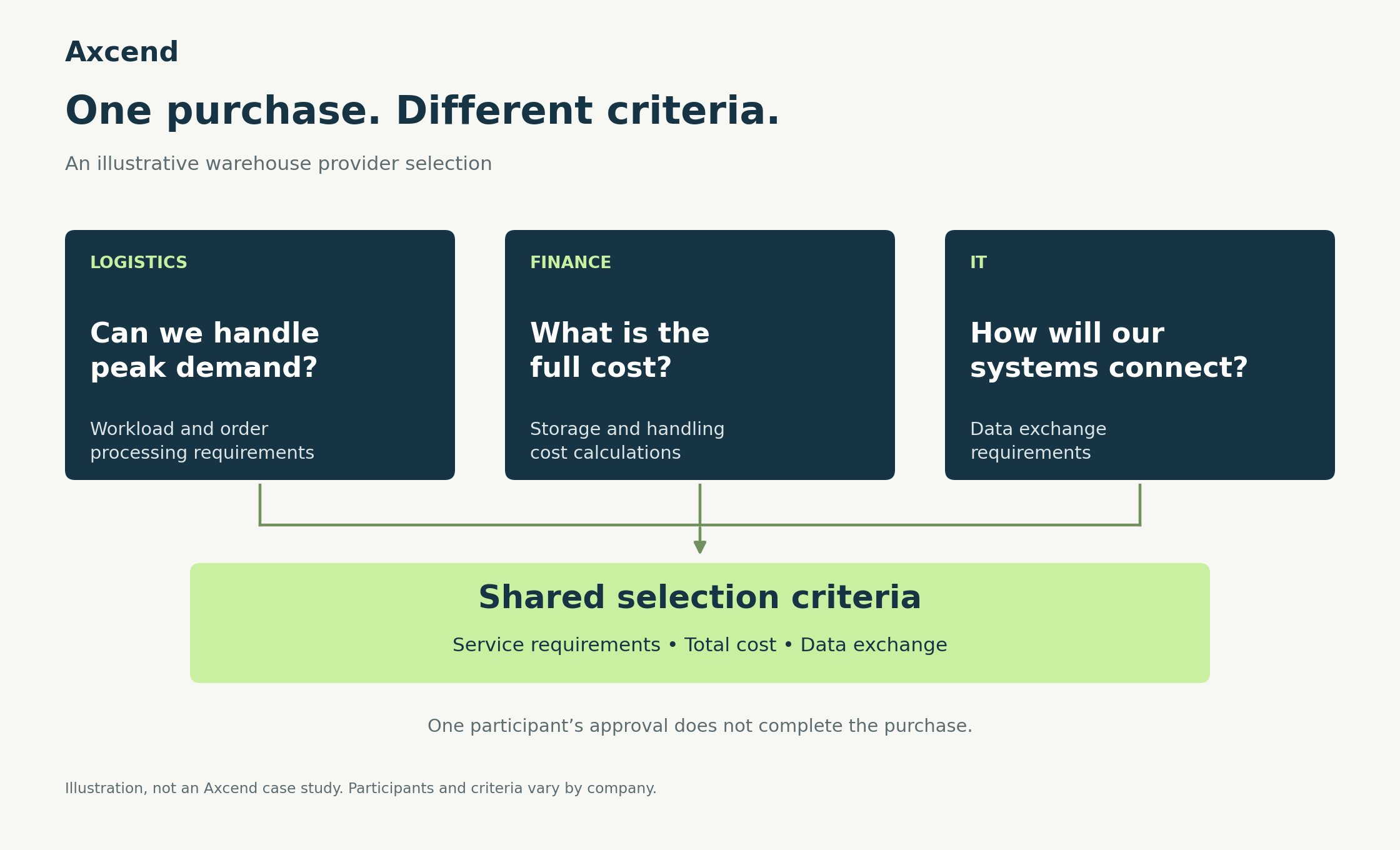
Illustrative example, not an Axcend case study. Participants and purchase criteria vary by company.
Gartner describes B2B purchasing as a nonlinear process in which participants revisit questions and complete different buying tasks in parallel. Returning to requirements does not necessarily mean that interest has disappeared. Gartner's guidance on B2B buying.
In this example, new information about integration costs might prompt finance to revisit the economics. Helping update the calculation would be more useful at that moment than repeating the warehouse facility's advantages.
Start with the story of an actual purchase
A workshop can quickly produce a tidy sequence: read an article, submit an inquiry, watch a presentation, buy. That sequence may capture the company's preferred scenario while revealing very little about how its customers decide.
Choose one recognizable type of purchase for the first map. Outsourcing warehouse operations while entering a new region would be a useful focus. Renewing an existing agreement and buying the service for the first time deserve separate treatment. People bring different knowledge, concerns, and alternatives to those decisions.
Reconstruct several purchases using correspondence, conversation records, and documents. Then ask buyers about what those materials cannot show. What prompted the search? Which alternatives did they consider before contacting a supplier? Who joined the discussion later? Where did the decision nearly stop?
Include accounts that did not buy. A company that stayed with its incumbent or postponed the project may reveal an obstacle absent from the success stories. One person's explanation should not automatically become the assumed position of the entire buying group.
Nielsen Norman Group recommends combining existing evidence with research into customers' actual experiences. Interviews help uncover motivations and difficulties, while observation and quantitative evidence can add to and test the picture. Guidance on researching customer journeys.
Keep confirmed facts separate from interpretations on the working map. “The finance director requested calculations for three workload scenarios” describes an event. “Saving money is the director's main priority” remains an interpretation until it is established. That distinction prevents a convenient assumption from becoming the basis for confident action.
Match each obstacle with a useful next step
The first map does not need an elaborate design. A productive deal discussion can begin by connecting the buyer's question, the missing information, and an action that would help resolve it.
| The buyer's question | What helps answer it | Evidence of progress |
|---|---|---|
| Why should we change the current arrangement? | An account of the problem and its consequences using customer data | Participants agree on the problem worth solving |
| Which approach would suit us? | A comparison of alternatives, including keeping the current model | The business establishes requirements for its chosen approach |
| Can this provider do the job? | A review of a specific use case, terms, and limitations | Responsible specialists confirm alignment with requirements |
| How can we start without disrupting operations? | A transition plan with task owners and acceptance criteria | The buyer agrees on the launch arrangements and responsibilities |
These questions do not form a mandatory sequence. Concerns about the transition may arise before vendor selection and shape the entire search.
In the warehouse example, logistics needs to discuss peak demand, finance needs calculations at different utilization levels, and IT needs to understand the exchange of data. One general presentation is unlikely to replace all three conversations. A seller can, however, help bring their conclusions into a shared set of requirements so participants compare offers on the same basis.
Include contact points on the map as well: where buyers research, whom they consult, and which materials they pass to colleagues. Every significant question needs an owner on the supplier's side. An article can explain the principles behind pricing. A specific estimate needs someone with the necessary inputs and authority.
During initial outreach, establish how much of this work the buyer has already done. If the company is still investigating the cause of operational failures, contract discussions may be premature. If requirements are approved and vendors are being compared, an introductory lecture on outsourcing will simply consume time.
A digital signal is a reason to ask
A pricing page visit, a downloaded guide, or webinar attendance can suggest interest. None automatically establishes an approved project, an available budget, or the visitor's purchasing authority.
A financial analyst might be collecting prices for an internal comparison. A competitor's employee might be reading the service description. An existing customer might be looking for an answer about their agreement. The same online action can support several explanations.
Use these signals to prepare a question rather than declare the account ready to buy. The difference becomes clear in the conversation: the seller asks what the person is investigating instead of immediately proposing a signature date.
Preserve that understanding when the contact moves to another team. At Axcend, we clarify the prospect's need and interest, then provide the client with the context of the conversations. For appointment setting, we also confirm readiness to discuss commercial terms. How Axcend hands over prospects.
The receiving salesperson needs to know what the buyer has confirmed, who else participates in the decision, and which question remains unresolved. If the customer must start the explanation again, some of the previous work loses its value in their eyes.
The map still matters after signing
For the supplier, a signed agreement closes the sale. For the customer, it begins the test of what was promised. Implementation, access to specialists, and performance under actual operating conditions now matter most.
For a warehouse operator, that might include receiving the first shipments, transferring inventory records correctly, and processing orders under the agreed arrangements. Discuss these matters before signing and pass them to the delivery team with the customer's expectations. Otherwise, implementation receives a contract without a clear explanation of what the customer bought it to accomplish.
This is also where the basis for future expansion develops. If the customer is still struggling with the initial rollout, an offer to increase the scope may arrive at the wrong time. First establish whether the business has achieved the outcome it expected.
Judge the map by changes in the work. Are fewer questions being reopened unnecessarily? Do the right specialists become involved sooner? Are launches less often delayed by issues that could have been discovered earlier? Meaningful comparisons require similar purchases and enough time to observe their development.
A useful map does not predict every customer action. It helps the seller understand the decision facing the people on the other side of the conversation. Another reminder about the proposal can then become a substantive discussion of what is preventing the company from moving forward.