
Before the first call, almost everything is ready: an account brief, background on the executive, a reason to reach out, and an email draft. Until recently, assembling that material could consume a meaningful part of a sales rep’s morning. Now AI can do much of the preparation. One question remains stubbornly difficult: Why should this person talk to us today?
That question sits at the center of the changing SDR role. Sales development representatives find prospective customers, open conversations, and establish whether there is a reason to move a sale forward. Faster preparation gives a team room to expect more from each conversation. It also gives the team an opportunity to send vastly more forgettable email.
Which outcome a company gets depends on management decisions. What work should the system handle? What counts as a useful result? And what should reps learn when producing a polished first draft takes almost no effort?
A Polished Email Can Still Misread the Buyer
Consider a hypothetical company selling procurement software. An AI system identifies a business opening new locations, gathers public information, and proposes an email to its CFO. The reasoning sounds plausible: expansion makes purchasing more complicated, so the business needs a new platform.
But the announcement establishes only that the business is opening locations. Purchasing might be managed centrally. The company might have replaced its software last quarter. Hiring might be the urgent problem, while procurement runs smoothly. A reason to make contact is useful. A confirmed need is a different level of information.
A rep could turn the assumption into a question: “As you add locations, are purchasing approvals staying with headquarters or moving to the local teams?” That gives the buyer something concrete to answer and lets the rep test whether the proposed problem exists.
Tools supporting this preparation are commercially available. HubSpot describes account research, contact sourcing, and personalized email drafting among its prospecting agent’s functions. Teams can review messages before sending or use an autonomous sending mode. The availability of those features does not establish their value for a particular sales organization.
A useful account brief should therefore answer three questions: What do we know? What are we assuming? What do we need to find out? Facts should come with a source and a date. Assumptions should be recognizable as assumptions. With that distinction intact, even a short briefing can support a thoughtful conversation.
Autonomy Needs a Clear Job Description
A sales leader needs more than a list of things an AI tool can do. The operating question is what it has permission to do without approval. An email draft, a sent email, and a commitment to a buyer carry different consequences, even when they look like similar blocks of text on a screen.
A reasonable starting point for a pilot is to have the system prepare material and a rep review it before acting. As results accumulate, the team can authorize specific actions without individual approval. Sending an approved meeting confirmation after both parties have agreed on a time is one candidate. Offering a discount or promising a custom integration calls for a different level of authority.
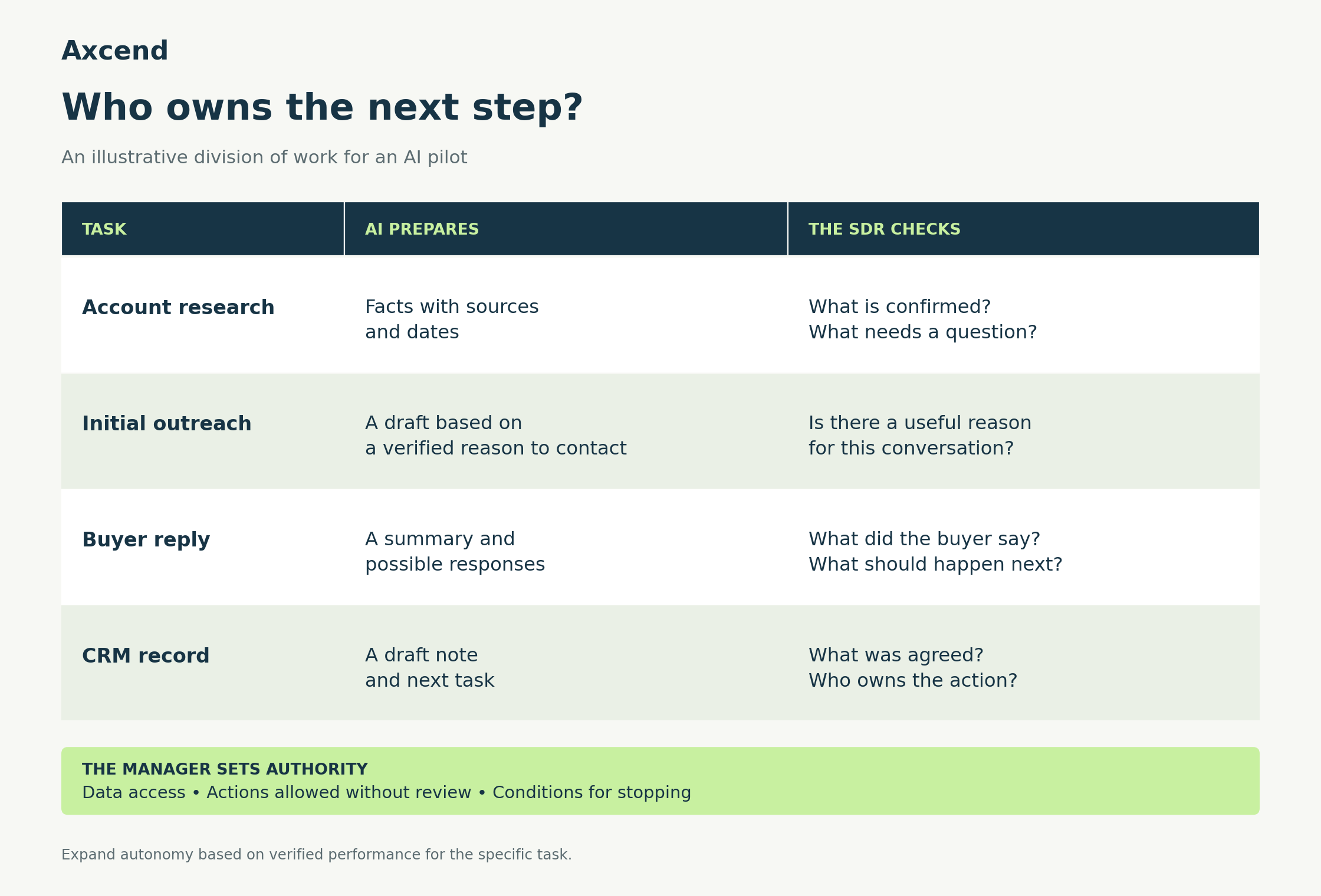
An illustrative division of work for a pilot. Appropriate autonomy depends on the task, system performance, and consequences of an error.
This distinction matters because generated text can sound more certain than the evidence warrants. NIST identifies confidently stated false information as a risk of generative AI. In sales, the consequences can be very ordinary: an invented office location, an incorrect job title, or a claim about a product feature that does not exist.
Review needs a specific purpose. For an opening message, verify the reason for reaching out. For a CRM update, check whether the buyer actually agreed to the recorded next step. A vague instruction to “make sure it looks good” can turn a rep into a rubber stamp for persuasive writing.
Data access needs the same clarity. Before connecting a tool, establish which records it can read, which fields it can change, and who can inspect its actions. Access to every customer conversation should not be the default simply because the integration makes it possible.
The Standard for a Good SDR Is Moving
Debates about the profession tend to jump to sweeping conclusions. One camp promises fully automated sales. Another assures reps that their jobs are safe. Neither statement helps a manager design the work of a particular team.
The International Labour Organization’s 2025 research examines exposure to generative AI at the task level and identifies job transformation as the most likely broad outcome. It assesses potential technological effects, rather than forecasting SDR headcount. The useful management principle is to examine the tasks inside a job before deciding what happens to the entire position.
In the procurement example, a rep needs to notice the weak assumption, ask a useful question, and understand the answer. If the CFO says the location budgets are already approved, does that answer the purchasing question at all? Continuing a product pitch because the account received a high score would miss the point of the conversation.
Training should reflect that challenge. Writing effective AI instructions is useful, alongside product knowledge, an understanding of the customer’s economics, and practice in conversation. One valuable coaching exercise is to review an account brief, identify unsupported conclusions, and explain which questions would test them.
New hires deserve particular attention. Reps who immediately receive completed briefs and email drafts may get less practice doing the underlying analysis themselves. During a call review, ask them to explain why they chose the account, what supported their assumption about its needs, and what changed after the conversation. That helps a manager see whether judgment is improving along with speed.
Count the Work That AI Creates, Too
Fast content production is easy to demonstrate. The economic result takes longer to establish because it includes review, corrections, software costs, and the quality of the opportunities produced.
Suppose preparation gets faster, but reps have to rewrite every other email. Or the team books more meetings, while account executives reject a large share after the initial conversation. In either situation, an impressive activity report can conceal work being shifted elsewhere in the sales process.
A pilot should begin with an agreed set of measures.
| What to evaluate | What to include | What it tells you |
|---|---|---|
| Time savings | Preparation, review, and corrections together | Whether the total workload has fallen |
| Outreach quality | Factual errors and substantive replies | Whether preparation supports useful conversations |
| Meeting quality | Meetings held and opportunities accepted by sales | Whether more suitable opportunities are emerging |
| Economics | People, data, and software costs per accepted opportunity | Whether the result justifies the expense |
Compare similar groups of accounts, assign them randomly where feasible, and keep qualification standards consistent. Changing the account list, offer, and outreach channel at the same time makes it difficult to isolate AI’s contribution. Give both groups an equal observation period that is long enough for the outcome being measured. Early meetings cannot establish a revenue effect when deals take months to close.
Decide in advance what the team will do with the time it saves. Reps might respond sooner to substantive replies, prepare for more demanding conversations, or revisit promising accounts that have been neglected. Without that decision, saved minutes can disappear into a higher email quota.
Accountability Is Still Part of the Sale
Buyers do not apply a separate quality standard to messages generated by AI. If a company approaches them with a mistaken assumption, that company has to correct it. If it promises something it cannot deliver, its team will have to resolve the problem. An automated process therefore needs an owner who can change the rules and stop a sequence that is going wrong.
For Axcend, the practical question is whether a tool helps a conversation reach a justified next step. Preparation should help the rep understand the situation. A handoff should preserve what was actually learned from the buyer. As material becomes faster to produce, maintaining that connection becomes more valuable.
The SDR job will continue to change with the tools available and the decisions employers make. Managers can already make a useful choice: teach reps to test assumptions, ask precise questions, and take responsibility for commitments. Those expectations give a quickly prepared message a better chance of becoming a conversation a buyer wants to make time for.